Sino-U.S. Energy Triangles: Resource Diplomacy Under Hegemony by David Zweig & Yufan Hao
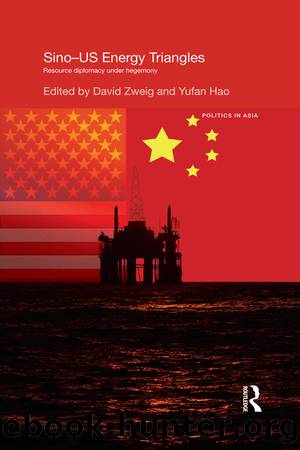
Author:David Zweig & Yufan Hao [Zweig, David & Hao, Yufan]
Language: eng
Format: epub
Tags: Political Science, International Relations, General, World
ISBN: 9781138778085
Google: P8zJoAEACAAJ
Goodreads: 21553579
Publisher: Routledge
Published: 2015-01-15T13:48:16+00:00
Trying to reinvigorate bilateral relations
During her 11-day visit to Africa in August 2009 (the longest ever to Africa by a US Secretary of State), Hillary Clinton visited seven African countries, including Angola. Along with South Africa and Nigeria, Clintonâs choice of Angola highlighted one of the administrationâs key priorities in Africa â the establishment of good relations with what is likely to become the three âanchor statesâ of sub-Saharan Africa.
Hillary Clintonâs mission in Angola was to build a strategic partnership between the two countries and followed a visit by the Angolan foreign minister to Washington in May 2009. In Angola, Clinton spoke of the two countries as âpartners, friends and alliesâ (Angola Press, 2009). When the US established diplomatic relations with Angola in 1993 during the Clinton Administration, the relationship was initially warm (see Partricio, 1997). Following the collapse of the Lusaka peace process and the resumption of war in the latter half of 1998, the Clinton Administration backed away from an active involvement in the search for peace in Angola. Instead, a concerted effort was made to strengthen the bilateral relationship with the Government of Angola through the establishment of the USâAngola Bilateral Consultative Commission, which met formally three times during 1999â2000 to discuss a wide range of issues.
The decision to visit Angola on Clintonâs maiden visit to Africa was seen in Luanda as proof that the US wanted to work constructively with the government of José Eduardo dos Santos. As a country in transition, Secretary Clintonâs approach to Angola was seen as pragmatic. She simultaneously called for good governance and presidential elections, while also declaring that the US was âsatisfiedâ with Angolan efforts so far and would encourage further efforts to promote transparency. Furthermore, Clinton stated that she was convinced that presidential elections would occur âin due courseâ upon ratification of the new constitution.
The US and Angola sought to resuscitate their bilateral consultative commission. In November 2009 in Washington DC, the US and Angola launched meetings under a new framework for sustained bilateral engagement, with working groups on energy and security cooperation. This was followed in July 2010 by Secretary Clinton signing an agreement in Washington for a Strategic Partnership Dialogue with Angolaâs foreign minister. In May 2014, US Secretary of State John Kerry visited Luanda briefly and congratulated Angola on its diplomacy as the chair of the International Conference of Great Lakes region. Kerry also said that the US and Angola would begin an âenergy dialogueâ about increasing economic cooperation in the areas of energy, technology, infrastructure and agriculture. The US Commerce Department also planned to open a commercial service office in Angola soon, according to Kerry. Although US officials hoped this would open a new chapter in bilateral ties between the two countries, this has not happened and President dos Santos did not attend the USâAfrica leadersâ summit in Washington DC in August 2014. Still, in early 2012, Sonangol withdrew from a natural gas project in Iran after the tightening of US-led sanctions on that country.
Download
This site does not store any files on its server. We only index and link to content provided by other sites. Please contact the content providers to delete copyright contents if any and email us, we'll remove relevant links or contents immediately.
| Anthropology | Archaeology |
| Philosophy | Politics & Government |
| Social Sciences | Sociology |
| Women's Studies |
Born to Run: by Christopher McDougall(7127)
The Leavers by Lisa Ko(6948)
iGen by Jean M. Twenge(5416)
Sapiens by Yuval Noah Harari(5370)
Spare by Prince Harry The Duke of Sussex(5197)
The Kite Runner by Khaled Hosseini(5179)
Machine Learning at Scale with H2O by Gregory Keys | David Whiting(4313)
Bullshit Jobs by David Graeber(4190)
Never by Ken Follett(3957)
Goodbye Paradise(3810)
Livewired by David Eagleman(3774)
Fairy Tale by Stephen King(3399)
A Dictionary of Sociology by Unknown(3085)
Harry Potter 4 - Harry Potter and The Goblet of Fire by J.K.Rowling(3074)
The Social Psychology of Inequality by Unknown(3031)
The Club by A.L. Brooks(2925)
Will by Will Smith(2920)
0041152001443424520 .pdf by Unknown(2846)
People of the Earth: An Introduction to World Prehistory by Dr. Brian Fagan & Nadia Durrani(2738)
